
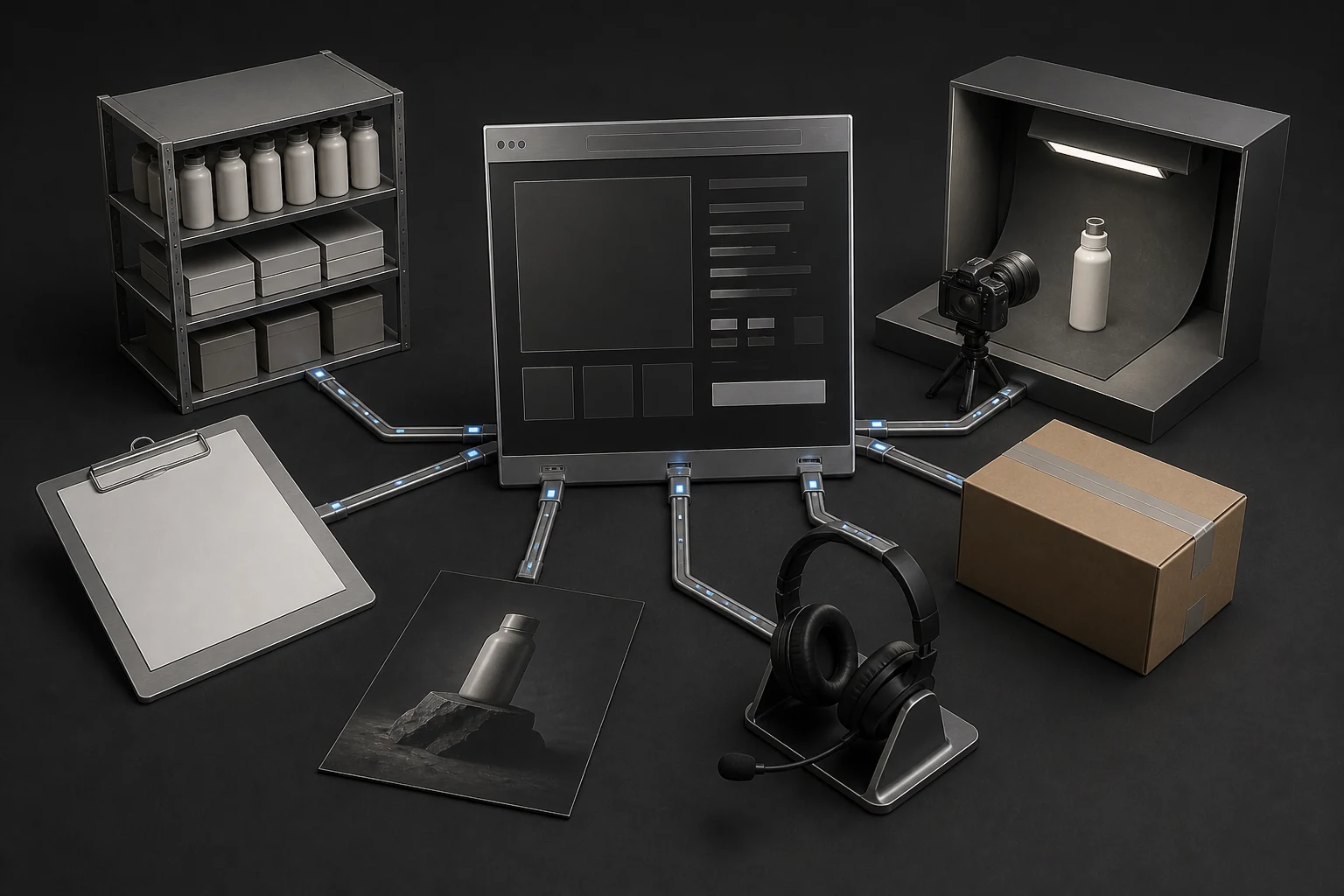
A staged delivery route from discovery through build to operation.

Web application development with scope before code

Accounts, permissions, relational data and workflow put a project into a different category of risk, testing and maintenance. It is worth knowing which side you are on.

The line

Four things put a project on the application side

Any one of them changes how it has to be built, tested and maintained.

Marketing sites and applications look similar in a design file and behave nothing alike in production. The distinction is not visual complexity. It is whether the system holds state that matters.

The first is accounts. As soon as users log in, there is authentication, session handling, password recovery, permissions and a real security surface. That is not a feature. It is a category change.

The second is relational data that users create. Records that reference each other, that have to remain consistent, and where an error is not a display problem but a wrong answer somebody acts on.

The third is workflow: states, transitions, approvals, notifications and audit. This is where most of the requirement lives and where most estimates go wrong, because a workflow described in a sentence takes a fortnight to build properly.

The fourth is anything with a compliance or financial consequence. Personal data at scale, payments, or records the business is required to retain. Those change the testing standard rather than the feature list.

The difference

What changes once it is an application

Not the design work. Everything around it.

Marketing site compared with a web application
ConcernMarketing websiteWeb application
FailureA page looks wrong until it is fixedData is wrong, and someone may already have acted on it
TestingVisual and journey checksAutomated tests around the logic that must not break
SecurityStandard headers and a formAuthentication, authorisation and an ongoing responsibility
DataContent, versioned in one placeUser-created records requiring backup, retention and recovery
ChangePublish, and the change is liveMigrations, releases and a rollback that has been rehearsed
MaintenanceDependency updates and contentDependency updates, monitoring, backups and support

This is why an application is never quoted from a written brief alone. The brief describes the features, and the cost sits in the states and the failure cases underneath them.

Discovery

Why a price follows discovery, not the other way round

A bounded, paid stage with its own deliverable.

It produces something you keep

A specification, a data model, a screen inventory and a prioritised build order. That is usable by any developer, including one who is not us, which is the point.

It separates the essential from the assumed

Most application briefs contain a version that is half the size and delivers most of the value. Finding it is the highest-return hour of the project.

It surfaces the integrations

Applications usually have to talk to something else. The other system’s API, its limits and its owner set the constraints, and finding them after a fixed price is agreed helps nobody.

It names who runs it afterwards

An application needs monitoring, backups, dependency updates and support. Deciding whether that is you, us or a third party is part of the design rather than a conversation after launch.

Discovery is credited against the build where the project proceeds.

Foundations

What is in place before the first feature

Retrofitting any of these costs more than building them.

These are the parts that are invisible in a demonstration and decide whether an application survives its second year.

  • Authentication and authorisation implemented against a known model, not improvised
  • A data model that has been reviewed before code depends on it
  • Automated tests around the logic where an error has consequences
  • Database migrations that are versioned and reversible
  • Backups with a restore that has actually been tested
  • Error monitoring that reaches a person
  • An environment separation that lets changes be tested with real-shaped data
  • A documented release and rollback process

A restore that has never been tested is not a backup. It is a belief about a backup, and it is usually examined for the first time on the worst possible day.

Money

What this work starts at

Published starting figures in GBP and USD, excluding VAT.

Application delivery

Scoped after discovery

Software, not a site

Web application or Shopify app

From £4,000From $5,200

Authentication, application behaviour, relational data, private merchant tooling or a custom Shopify app. Requirements beyond what a marketing site or a theme can hold.

  • Private dashboards and merchant workflows
  • Admin API integrations and signed webhooks
  • Relational data, accounts and permissions
  • Maintenance ownership agreed before build

Starting price · scoped after discovery

One bounded piece

Project sprint

£1,500$2,000

One bounded improvement: landing pages, a template rebuild, an analytics implementation, or a build-readiness review credited against a larger project.

  • One defined outcome, agreed before work starts
  • Fixed price and a fixed finish line
  • Credited against a larger project where it leads to one

Fixed price

Ongoing responsibility

Monitoring, updates and capacity

Per month

Optimisation

From £1,250From $1,650

A live improvement programme on one site. You set the priorities each month, we work the queue in order, and the month closes with what changed and what it did.

  • Outcome: measurable improvement to one live site
  • Queue: one active workstream, reprioritised monthly
  • Response: next working day
  • Scope: conversion, SEO, content and development work

Starting price

Per month

Development partner

From £3,000From $4,000

Continuous delivery across an agreed portfolio, with planning ahead of the work rather than a queue you have to keep feeding.

  • Outcome: continuous delivery across your estate
  • Queue: two active workstreams, planned a month ahead
  • Response: same working day, UK working days
  • Scope: Shopify and marketing-site delivery, plus roadmap planning

Starting price

Applications are not instant-priced. Discovery is quoted on its own and credited against the build, because a fixed price offered before the data model exists is a number chosen for its persuasiveness.

Questions

Asked before this work is agreed

Can you give a fixed price?

After discovery, usually yes for a defined first release. Before discovery, no. A fixed price quoted from a written brief is either padded heavily or destined for a difficult conversation, and neither serves the project.

Should this be an application at all?

Sometimes not. A configured off-the-shelf tool, a spreadsheet with a proper process, or a small addition to a system you already run can be the better answer. We would rather say that than build something that duplicates a product you could subscribe to.

Who owns the code?

You do, on the terms set out in the agreement, and it lives in a repository you control. Nothing is held in an account only we can reach.

What happens after launch?

Applications need monitoring, dependency updates, backups and support. That is agreed as part of the project: it can be our ongoing responsibility, your team’s, or a third party’s, but it has to be somebody’s and it should be named before launch.


Send the process you are trying to replace.

The current spreadsheet or manual workflow describes the requirement more accurately than a feature list.

Discuss a project