
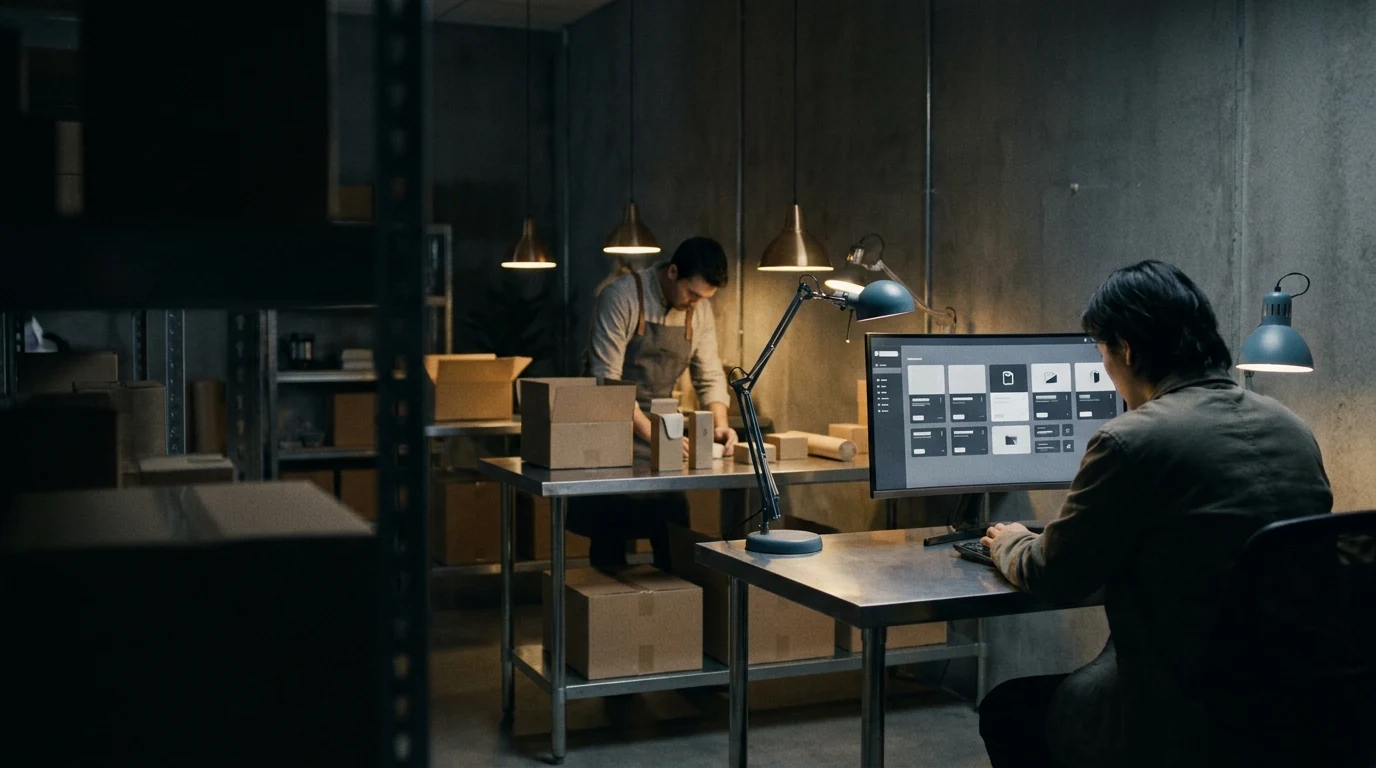
An ecommerce operator reviews an unbranded product journey while a colleague checks physical stock and packed orders.

Shopify CRO starts with the buying journey

Diagnosis first, then changes to the journey, then measurement that can actually attribute them. No promised uplift, because nobody can honestly promise one.

The position

A conversion rate is an outcome, not a lever

It moves when something in the journey changes, or when the traffic does.

Conversion rate is a ratio, and it can fall while a store is doing better. Add a new paid channel and the rate drops before the revenue rises. Fix stock availability and it moves for reasons no page change caused.

That is why work starts with the journey rather than with a list of tactics. Which step loses people, how many, and what were they trying to do when they left. Until that is established, changing button colours is a way of spending budget while feeling productive.

We do not guarantee an uplift, and we would be sceptical of anyone who does. What we commit to is a diagnosis that names where the losses are, a prioritised set of changes, an implementation that does not break anything, and measurement honest enough to tell you when a change did nothing.

Where it goes

Four places stores lose the sale

In roughly the order they are underestimated.

These are the patterns that recur across catalogue stores, and they are rarely where the design conversation starts.

Nobody reaches the right product

On a wide catalogue, discovery is the conversion problem. If filtering, collection structure and internal search do not narrow a range quickly, most visitors never see the product that would have converted them.

The product page leaves a question open

Sizing, compatibility, delivery timing, returns and stock. An unanswered question is a deferred decision, and a deferred decision on a phone is usually a lost one.

The cost is not known until checkout

Delivery cost and timing revealed late is one of the most reliable ways to lose a completed basket. Where a threshold exists, it should be visible where the decision is made, not on the final step.

The journey breaks quietly

A variant selector that fails on one browser, an app that blocks rendering on mobile data, a validation error that says nothing useful. These do not show up as design problems and they are frequently the largest single loss.

Fix the largest loss first, even when it is the least interesting one.

Evidence

What each source can answer, and what it cannot

Most disagreements about CRO are really disagreements about evidence.

Evidence sources, their use and their limits
SourceWhat it answers wellWhat it cannot tell you
Analytics funnelsWhere volume drops between steps, and on which templates and devicesWhy anyone left, or whether they came back later on another device
Session recordingsWhat broke, what confused people, and which interactions were attemptedAnything about frequency or significance, because you watch a biased sample
Store search and supportThe questions the site failed to answer, in the customer’s own wordsHow many people had the question and did not ask it
Split testsWhether a specific change beat a specific alternative on this trafficAnything useful at low order volumes, where results are mostly noise
Order and returns dataWhich decisions were made badly, especially sizing and compatibilityWhat the visitors who never ordered were struggling with

Most stores do not have the order volume for reliable split testing. Saying so is more useful than running a test that cannot conclude and reporting the result anyway.

Prerequisites

What has to be true before measurement means anything

Measuring against broken instrumentation is worse than not measuring.

A surprising share of conversion projects begin by repairing the measurement that was supposed to prove they worked.

  • Commerce events firing once, on the right templates, with the right values
  • Consent handling that does not silently drop a large share of sessions
  • Server-side and client-side numbers reconciled against Shopify’s own order data
  • Traffic segmented so a paid campaign does not distort a template comparison
  • A baseline recorded before the first change is published
  • Changes released one at a time where attribution matters
  • Stock availability and price changes noted, because they move the rate on their own

Where the instrumentation is broken, fixing it is the first project. It is unglamorous and it is the only thing that makes the rest of the work assessable.

Money

What this work starts at

Published starting figures in GBP and USD, excluding VAT.

Conversion projects

Bounded, with a written outcome

One bounded piece

Project sprint

£1,500$2,000

One bounded improvement: landing pages, a template rebuild, an analytics implementation, or a build-readiness review credited against a larger project.

  • One defined outcome, agreed before work starts
  • Fixed price and a fixed finish line
  • Credited against a larger project where it leads to one

Fixed price

Migration and build

Shopify launch

From £5,000From $6,500

Moving to Shopify and building the store in one project, so the data and the storefront land together rather than in two disconnected pieces of work.

  • Store build, configuration and templates
  • Managed data migration within stated limits
  • Redirects, analytics and technical SEO baseline
  • Launch, training and short post-launch support

Starting price

Continuing optimisation

Where the work is a programme, not a project

Per month

Optimisation

From £1,250From $1,650

A live improvement programme on one site. You set the priorities each month, we work the queue in order, and the month closes with what changed and what it did.

  • Outcome: measurable improvement to one live site
  • Queue: one active workstream, reprioritised monthly
  • Response: next working day
  • Scope: conversion, SEO, content and development work

Starting price

Per month

Development partner

From £3,000From $4,000

Continuous delivery across an agreed portfolio, with planning ahead of the work rather than a queue you have to keep feeding.

  • Outcome: continuous delivery across your estate
  • Queue: two active workstreams, planned a month ahead
  • Response: same working day, UK working days
  • Scope: Shopify and marketing-site delivery, plus roadmap planning

Starting price

A diagnostic and a prioritised implementation plan can be delivered as a bounded project. Continuing optimisation is monthly capacity, because the value is in the sequence of changes rather than in any single one.

Questions

Asked before this work is agreed

Can you guarantee a conversion rate increase?

No. Conversion depends on product, price, stock, offer, service and traffic mix as well as the site, and a guaranteed figure would require control over all of them. We commit to a diagnosis, a prioritised plan, a clean implementation and measurement that reports honestly, including when a change did nothing.

Do we have enough traffic for split testing?

Frequently not, and it is better to say so. Below a certain order volume a test cannot reach a conclusion in a sensible period, so the work is prioritised by diagnosis and released in sequence with the effect observed against a recorded baseline.

Where do you usually start?

With measurement integrity and the largest observable drop in the journey. That is often discovery on a wide catalogue, or delivery information on a store with a high basket-abandonment rate, rather than the product page everyone expected.

Is this separate from a redesign?

Usually yes, and deliberately. A redesign changes many things at once, which makes attribution nearly impossible. Conversion work is sequenced so the effect of a change can still be seen.


Send the journey you think is losing people.

Store, main traffic sources and where you believe the drop is. If the evidence points somewhere else, that is worth knowing early.

Discuss a project