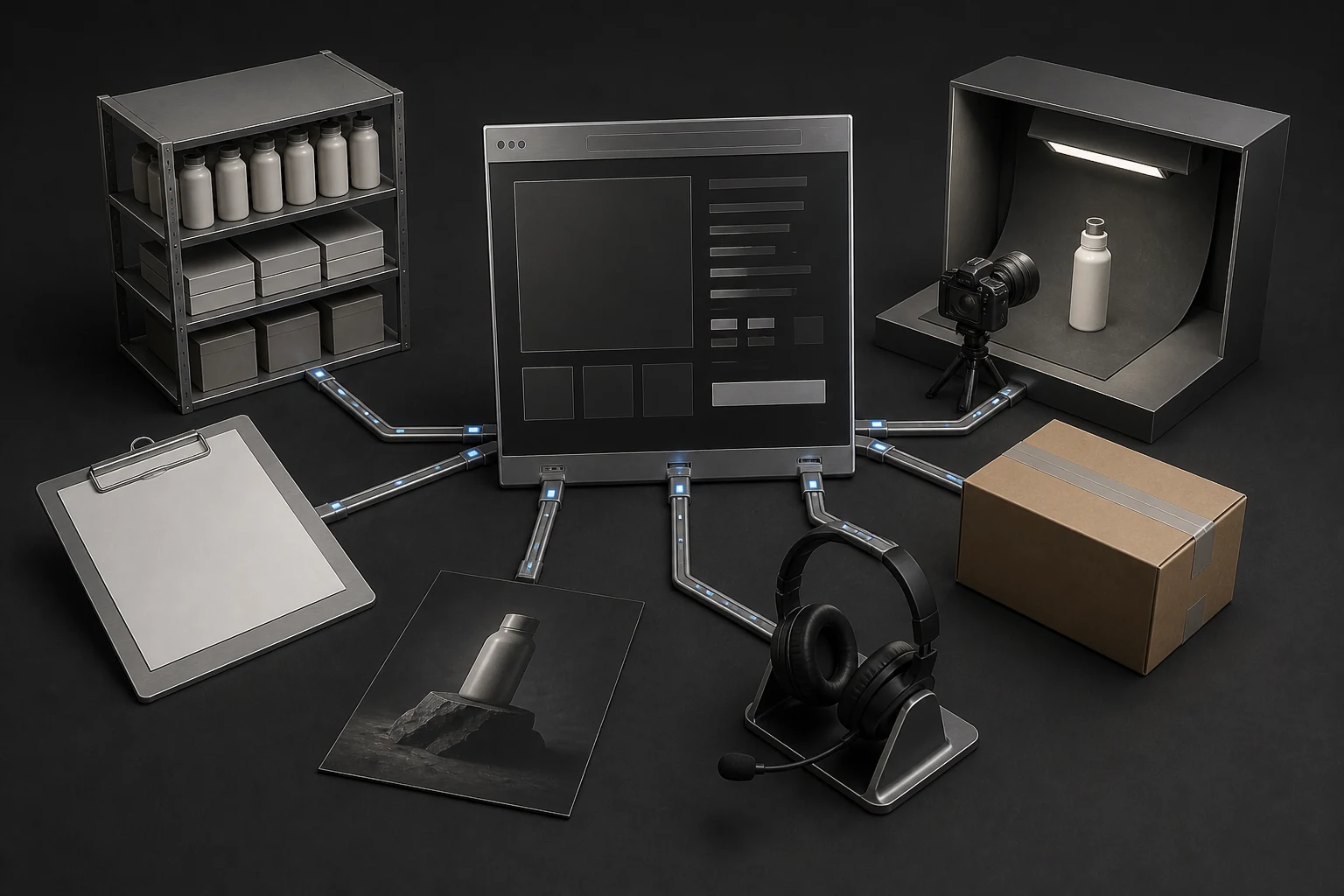
An authored plate of a storefront connected to the catalogue and operations around it.

AI developer for commerce and operations

We build AI into the systems you already run, with the scope defined first and one person accountable for it.

We build stores, websites and web applications.

The test

Start by ruling AI out

A rule or an existing product often covers it.

The useful question is which part of a workflow genuinely needs judgement, and whether something simpler already covers everything around it.

A fixed rule suits work with a definite answer: a threshold, a mapping, a status change or a document that always arrives in the same format. It is predictable and repeatable. Where a rule covers the work, a model adds no useful judgement.

An existing product may already cover the requirement. A helpdesk, PIM, reporting tool or Shopify app can replace a custom build, with its supplier responsible for the product roadmap.

What is left is the part that reads language, weighs an incomplete case, or handles information that arrives in a different shape every time. That is the part worth building around a model, and defining it is what the scope has to settle first.

Where it fits

Workflows AI handles well

Each one reads language or handles information that changes shape.

Swipe the workflows

Merchandising

Catalogue and product data

Descriptions, attributes and categorisation across a large catalogue, where source data arrives in a different shape from each supplier.

  • Supplier feeds normalised into your own structure
  • Draft copy and attributes queued for approval
  • Written back only through routes you have agreed

Service desk

Support and document triage

Classifying, routing and drafting replies to tickets, emails, invoices and supplier documents that arrive in free text.

  • Classified and routed before anything is sent
  • Replies drafted for an agent rather than sent
  • Anything uncertain handed to a named person

Finance

Document extraction for reconciliation

Reading figures from invoices, statements and reports that arrive in different layouts, then queuing them for comparison with source records.

  • Source record linked beside each extracted figure
  • Differences queued for a person to check
  • Read access only unless writing is agreed separately

In-product

AI features in existing software

A search, summary or drafting feature inside the store, portal or application your team already opens daily.

  • Built into the interface people already use
  • Scoped against the existing API and permissions
  • Designed so the AI step can be switched off
Control

What the software does and who decides

The model proposes. Agreed permissions and approval rules decide what happens next.

Each action, the permission it runs under, and where a person decides
What the software doesHow it runsWhere a person decides
Reads records from a connected systemRead-only credentials, scoped to the fields it needsAccess is agreed before anything is connected
Classifies, drafts or summarisesThe output is a proposal, held rather than actionedChecked on screen before it counts as done
Writes back to a live systemOnly through a defined action under its own restricted credentialApproved by a named user before each write, unless the agreement explicitly permits automatic writes to named fields
Meets a case it cannot handleRouted out of the automated pathPicked up by a named person, with the context attached
Spends money on model and API usageBudget and rate limits set per workflowThe ceiling is agreed up front and alerted on
Anything it has already doneLogged with the input, the output and the identity usedReviewable afterwards without having to ask us

The permissions hold whether the model behaves well or not.

How it runs

From scope to handover

Every stage ends with something you can act on.

A scope you could hand elsewhere

The workflow as it runs today, the part worth automating, what the software may and may not do, and the acceptance criteria it will be judged against. It is a usable document for any developer, including one who is not us.

A working version, early

Where the main risk is model performance on your data, we test a sample of your own cases before pricing the rest of the build.

The build, inside your stack

The interface, integrations, permissions and logging are placed where the work already happens, where the existing system supports it.

A handover, then your choice

Documentation, a walkthrough for the people who will run it, and the access they need to do that. Ongoing support is a separate monthly decision rather than a condition of the build.

Discovery is quoted on its own and credited against the build.

Before launch

Before it touches live data

Reliability, permissions, handoff and shutdown are agreed before launch.

A demonstration can show whether the idea works on a sample. These checks determine whether it is ready for live data.

  • A test set built from your real cases, with the correct answers agreed by your team
  • Accuracy measured against that set, with the failure rate written down as a number
  • The cases it gets wrong examined, so the cost of each kind of error is known before launch
  • Permissions verified as the software actually runs, not as the design intended
  • Every action logged with its input, its output and the account that performed it
  • A defined route for anything the software will not handle, ending with a named person
  • Model and API spend capped per workflow, with an alert before the ceiling
  • A tested route for switching the AI step off, agreed while it is being designed

Each of these is agreed with your team before anything runs on live data.

Money

What this work starts at

Published starting figures in GBP and USD, excluding VAT.

Build

Scoped after discovery

Software, not a site

Web application or Shopify app

From £4,000From $5,200

Authentication, application behaviour, relational data, private merchant tooling or a custom Shopify app. Requirements beyond what a marketing site or a theme can hold.

  • Private dashboards and merchant workflows
  • Admin API integrations and signed webhooks
  • Relational data, accounts and permissions
  • Maintenance ownership agreed before build

Starting price · scoped after discovery

AI application delivery starts at £4,000 after discovery. Discovery is quoted separately and credited against the build if you proceed. Model and API usage is separate and depends on the provider and volume. Prices exclude VAT.

Questions

Asked before this work is agreed

What does an AI developer do?

Turns a defined business requirement into software that uses a model where judgement is genuinely needed. Most of the work is the ordinary part: the interface, the integrations, the permissions, and the checks that catch a wrong answer before anyone acts on it.

Do we actually need AI for this?

Often not, and it is worth establishing first. A fixed rule is cheaper and more predictable, and an existing product may already do it for a subscription. AI earns its place where the input is language, the case needs judgement, or the information arrives differently every time.

Can you add AI to software we already run?

Where it has an API and permissions can be scoped, usually yes. We review what the system will let a new component read and write before confirming the approach, because that constraint shapes the design more than the choice of model does.

What happens when the model gets it wrong?

We assume it will. Before launch we measure it against a test set of your real cases and decide what each kind of error costs. The design follows from that: approval before anything is sent or written, a route to a person, and a log of what happened.

How much does an AI project cost?

AI application delivery starts at £4,000 after discovery, excluding VAT. Discovery is quoted separately and credited against the build if you proceed. Model and API usage is separate and depends on the provider and volume.

Should we hire a developer instead?

If you already have people to scope it, review the output and run it afterwards, a senior contractor may well be enough. Where nobody owns the workflow end to end, what is worth buying is one accountable party covering discovery, build, integration and a handover that names who runs it afterwards.

What happens to our data?

Before anything is connected, the scope names which data may be sent to a model provider and which must not. Provider retention and training terms are reviewed during model selection, and the agreed restrictions become acceptance criteria for the build.

Who owns the code and the prompts?

You do, on the terms set out in the agreement. Ownership, and what happens to prompts and configuration at handover, is settled in writing before the build starts rather than left to assumption.

Do you only do this for Shopify businesses?

No. The pattern holds wherever the workflow lives: a catalogue, a helpdesk, a finance system or your own application. Commerce and operations are where we have the most context, which is why the examples on this page come from there.

Send the workflow you want to change.

How it runs today, who touches it and where it goes wrong tells us more than a feature list, including whether AI is the right answer at all.

Discuss a project