
The state of ecommerce in 2026
What changed, what didn’t, and what retailers should do next
14 August 2026 · Edition one · 48 sourced claims · about 14 minutes
Introduction
What this report covers, and who it is for.
Ecommerce did not get smaller this year. It got harder to be found in, and the reason is not the one most articles gave you.
Demand is strong. Online sales were 29.4% of all British retail in June 2026, the highest share since April 2021.[C01] In the United States, ecommerce grew 9.8% year on year while retail as a whole grew 3.9%.[C06]Nothing in the national statistics supports the idea that shoppers are leaving.
Discovery changed. Search engines now answer questions on the results page, and more of the web is read by machines than browsed by people.[C08][C11] A shopping assistant reading your catalogue will not add a product to the basket to find out what delivery costs.
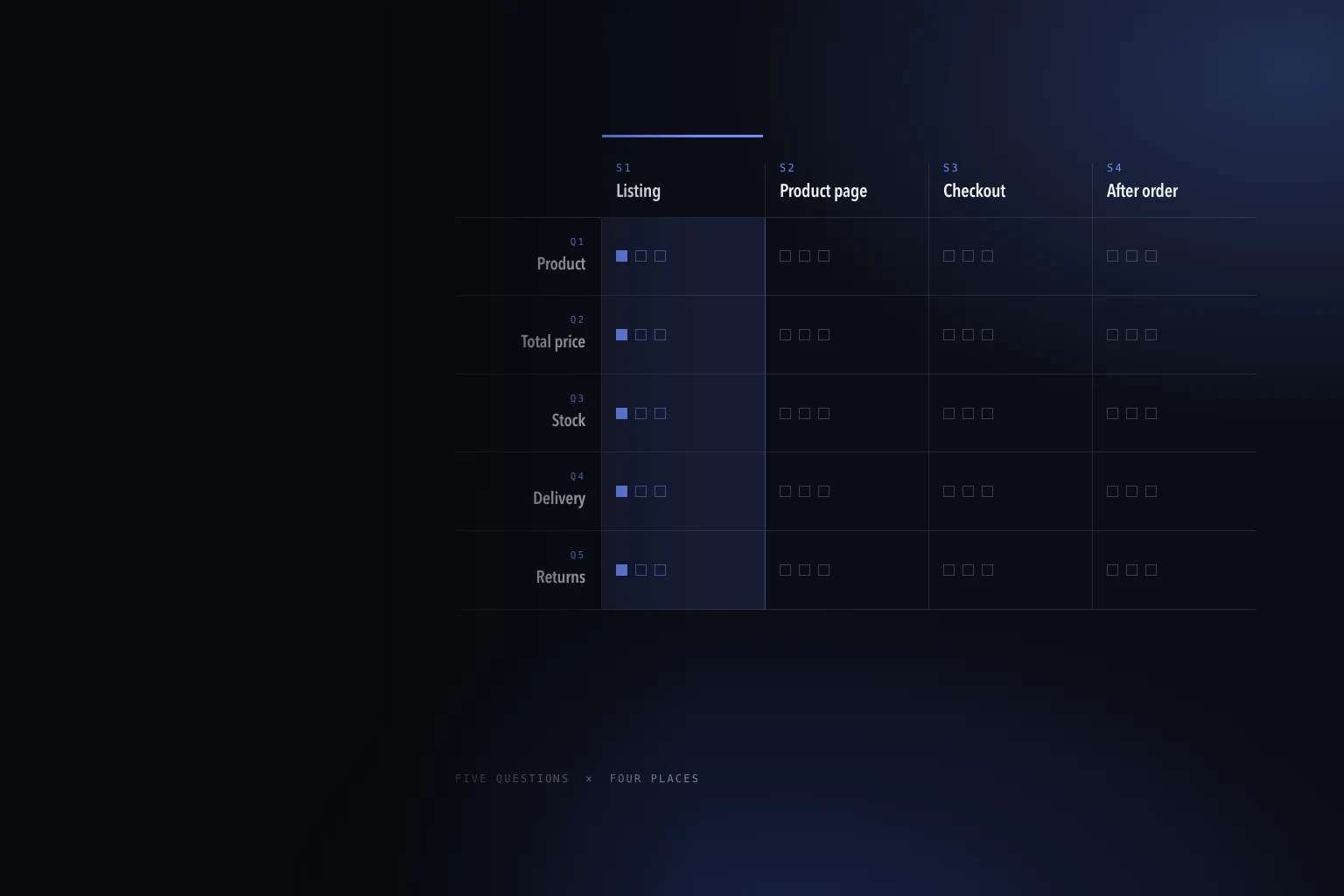
This report separates the two, and it ends with an audit rather than a trend list: a twenty-cell check you can run on one product page in an afternoon, covering the five things a buyer has to settle before they can order.
Key findings
Six measurements that between them describe the year. Each is published by a named organisation on a stated date.
29.4%
of UK retail sales were made online in June 2026, the highest share since April 2021
ONS · C01
9.8%
US ecommerce growth year on year, against 3.9% for retail as a whole
US Census Bureau · C06
8%
of Google visits produced a click on a result when an AI summary appeared, against 15% without one
Pew Research Center, 2025 data · C08
54%
better conversion from visits referred by AI tools than from other traffic sources
Adobe Analytics · C15
£4.7m
in fines in the UK regulator’s first year of direct consumer enforcement
CMA · C29
12%
rise in the average price Meta charged for an advert, year on year
Meta Platforms · C22
Nothing in the demand data explains a fall in your traffic. What changed is who gets the click.
UltraLabs analysisEcommerce demand remains strong
Before anything about AI, the demand picture. It rules out the explanation most people reach for first.
27.4%
was the online share for the whole of 2025, still below the 2021 peak of 30.7%. The monthly figure reached 29.4% in June 2026, the highest since April 2021.[C01]
Swipe a chart sideways to read it
Source. ONS series J4MC, Retail Sales Index (DRSI), released 24 July 2026. Annual values; the monthly figures in this series retain retail seasonality, so they differ from the seasonally adjusted proportion in the ONS bulletin. [C04]
What this means. Online share took eleven years to climb from 3.4% to 19.2%, gained the same ground again in eighteen months, then fell back. Four years later it has still not returned to the 2021 peak. This is a healthy channel growing slowly, not a boom and not a collapse.
AI search is reducing clicks, not online demand
A store is now read, at scale, by software that will never add a product to the basket to find out what delivery costs.
Swipe a chart sideways to read it
Source. Pew Research Center, 22 July 2025. Browsing data from 900 US adults across 68,879 searches in March 2025, 12,593 of which produced an AI summary. This is 2025 evidence and is labelled as such wherever it appears. [C08]
What this means. Where a summary appeared, clicks on a normal result fell from 15% of visits to 8%, and the share of visits that ended there rose from 16% to 26%. Links inside the summary itself were clicked on 1% of visits.
Source. Adobe Analytics, May 2026, based on more than a trillion visits to US retail sites, as reported by Digital Commerce 360 on 17 June 2026. Adobe’s own pages were unreachable from our build environment, so this is trade reporting of a primary dataset. [C15]
What this means. A year earlier this traffic converted at roughly half the rate of everything else. The visits are not just more numerous now. They are longer, deeper and worth more.
AI search is changing who gets the click. It is not reducing ecommerce demand.
UltraLabs analysisThe correction worth printing
Google says markup is not the route into AI answers
A large amount of 2026 advice sells structured data as the way in. Google’s own documentation says the opposite: structured data is not required for its generative AI features, there is no special schema for them, and content rewritten for AI systems does not help.[C21]What the same page recommends is publicly accessible, crawlable content and a Merchant Center product feed.
On Shopify, AI-driven orders grew fast and then grew much less fast
Shopify reported AI-driven traffic up 8× and AI-driven orders up nearly 13× year on year in the first quarter of 2026.[C35] A quarter later both measures were about 3×, and the company described AI as a complement to search rather than a substitute, with traditional search still around a third of storefront sessions.[C36]Both are company operating metrics with no published definition, so they are reported here as what a platform says about itself.
Swipe a chart sideways to read it
Source. Shopify Q1 2026 earnings call, 5 May 2026; Q2 2026 earnings call, reported 5 August 2026. Both are company operating metrics. Shopify has not published how AI-driven traffic is identified and the figures are not independently audited. [C35]
What this means. Each multiple is measured against the same quarter a year earlier, and a year earlier the base was small, so a fall from 13× to 3× is arithmetic as much as it is demand. The channel is real and its growth rate is coming down.
What the agent shopping standard actually reads
Since January 2026 there has been a published standard for agent commerce with a governing council and a specification anyone can read. Its four capabilities in this release are checkout, identity linking, order events and payment token exchange.[C42] Discovery is not among them, so being found still runs on crawlable pages and product feeds. Google’s Shopping Graph holds over 50 billion listings with more than 2 billion refreshed hourly,[C40]and eligible Shopify products are listed in Shopify Catalog by default with nothing for the merchant to configure.[C38]
The competition is concentrated at the transaction rather than at discovery. Shopify Payments handled 68% of the platform’s global merchandise volume in the second quarter of 2026,[C45]Shopify now sells the agent channel to businesses that are not on Shopify,[C38]and the one in-chat checkout that launched reached about a dozen Shopify merchants before it was scaled back.[C43] None of that is something a retailer controls. What a retailer does control is whether the product facts are good enough to be chosen.
The law and your ad costs now push the same way
Every fact a shopping assistant wants early is a fact a regulator now also wants early.
£4.7m
in fines in the UK regulator’s first year of direct consumer enforcement, across 14 investigations, with£760,000 of consumer refunds ordered. Drip pricing, where part of the price appears only later in the journey, is treated as automatically unfair.[C29]
Cross-border costs moved the same way. The United States suspended duty-free de minimis treatment for all countries from 29 August 2025[C33], and the European Union is removing its €150 customs duty exemption. The European Accessibility Act has applied to ecommerce services since 28 June 2025[C34], which matters here for a simple reason: a fact that cannot be perceived has not been stated.
Swipe a chart sideways to read it
Source. Meta Platforms, second quarter 2026 results, 29 July 2026; Amazon.com, second quarter 2026 results, 30 July 2026. Meta figures are Family of Apps advertising metrics; Amazon figures are reported segment net sales. [C22]
What this means. Meta delivered 14% more adverts and charged 12% more for each. At Amazon the fastest-growing line is neither the shop nor the marketplace. It is advertising.
A machine cannot infer the delivery date, return cost or exact variant your product page never states.
UltraLabs analysisHow much of your demand depends on one channel?
We are asked often whether paid social is going to get harder. We have no forecast, and the published numbers do not support one in either direction. Meta’s total costs and expenses grew 55% year on year in the second quarter of 2026 against 28% revenue growth, with 2026 capital spending guided at $130bn to $145bn.[C22] Read that 55% carefully: it includes $2.40bn of legal charges and $1.18bn of severance, so roughly a quarter of the increase is one-off rather than recurring. A business funded by advertising still has reasons to want more from each unit of attention, and some of the context an advertiser used to buy is moving to the assistant: Google began letting shoppers connect Gmail and Google Photos to AI Mode in January 2026.[C47]
The evidence also runs the other way. Meta delivered 14% more adverts, charged 12% more for each and grew revenue 28%, which is not the shape of a channel in retreat.[C22]The personal-context feature is opt-in, runs as a Labs feature and is limited to paying subscribers in one country.[C47] Our confidence that paid social gets structurally harder is low, and we are not forecasting a slowdown.
UltraLabs analysis
The number that decides this is yours, not Meta’s
It is the share of your revenue arriving through one paid channel, which you can calculate this week. Concentration is not a prediction about a platform. It is a fact about your own business, and it is why the audit below pays whichever way the channels move.
Five questions every product page should answer
Not benefits, and not reasons to buy. These are the five facts that have to be true and findable before an order can happen.
- Q1
Is this exactly the product I mean?
The right product
Goes wrong asWrong variant, missing specification, unstated compatibility, ambiguous condition.
- Q2
What will I pay in total?
The total price
Goes wrong asDelivery, tax, duty or handling revealed after the shopper has committed attention.
- Q3
Do you have it in stock?
Stock
Goes wrong asStock state absent, stale, or true in the warehouse and false on the page.
- Q4
When will it arrive?
Delivery
Goes wrong asNo date before checkout, no tracking, no plan for the delivery that goes wrong.
- Q5
What happens if it is wrong?
Returns
Goes wrong asReturns terms unfindable, conditional in ways the page does not say, or contradicted on arrival.
Where your store answers, and how answers go wrong
- S1
Listing and feed
Everything readable without interacting: the page HTML, the category listing, the product feed.
Read by machines first
- S2
Product page
The pages a person reads once they have arrived and are considering the purchase.
Read by the shopper
- S3
Basket and checkout
Where the number becomes the amount the customer is actually charged.
Where it becomes binding
- S4
After the order
Confirmation, tracking, delivery exceptions, returns and support.
Where it is kept or broken
The rule
Every question must be answerable in the listing, and the answer must be the same in all four places
The listing and feed is the only place available to a reader that will not interact. It is also what a shopper sees in a search result, a comparison or an assistant’s answer. If the fact is not there, the store is not in the consideration set, and no analytics package will tell you it happened. The distance between where your store answers a question and where the buyer asks it is what we call the resolution gap.
Failure one
A missing answer
A question first answered further down the journey. Delivery cost that only appears in the basket. Stock state that only appears once a variant is chosen.
What it costs. Consideration you never observe. The reader that could not settle the question never became a session, so there is no bounce and no exit page to find.
Failure two
A contradictory answer
The same question answered differently in two places. £4.99 delivery on the listing and £7.95 at checkout. "In stock" on the category page and a three-week lead time on the product page.
What it costs. The sale at the point of highest intent. In the UK it is also the exact shape of the practice the regulator has been fining.[C29]
The product page audit
Five questions down, four places across. Take one product and mark each cell answered, contradicted or missing.
| Question | S1Listing and feed | S2Product page | S3Basket and checkout | S4After the order |
|---|---|---|---|---|
| Q1The right product | Title, variant, key specification and condition in the markup and the feed, not only in a photograph. | Enough detail to tell two similar products apart without contacting anyone. | The basket line names the exact variant that was chosen. | The confirmation and the packing note match the page. |
| Q2The total price | Price, delivery and any duty or fee knowable before interaction, per destination. | The full total stated on the product page, not deferred to the basket. | The amount charged equals the amount stated. Nothing new appears. | The receipt breaks down what was charged and why. |
| Q3Stock | Stock state per variant, current, and honest about backorder or made to order. | Availability shown where the variant is chosen, not only at the basket. | No silent substitution, no quantity surprise at payment. | A short-shipped order is explained before the customer notices. |
| Q4Delivery | A delivery expectation attached to the product and destination, not a generic policy page. | A date or a range on the product page, with the cut-off that produces it. | The choice of service, its cost and its date, in one view. | Tracking that works, and a route when it does not arrive. |
| Q5Returns | Return window, who pays and any exclusions, readable without a click. | The same terms next to the buy button, in the shopper’s own words. | No new condition introduced at the moment of payment. | A return that can be started without an email, and a refund with a stated time. |
The best product page answers five questions before the customer has to ask them.
UltraLabs analysisFix these in this order
Most stores that run this find eight or ten things wrong and fix the easiest four, which are rarely the four costing the money.
- Fix the contradictions firstCheap to correct, legally exposed, and destroying the traffic you paid most for. Reconcile the delivery number across listing, product page, basket and checkout before anything else.
- Then close the listing gaps on total price and deliveryExtra costs are the largest stated reason for abandonment and slow delivery is the second. A further 12% say they could not calculate the total up front.[C28]
- Then make stock true, not just presentStock is the answer most likely to be stated and wrong, because it depends on operations rather than on the website.
- Then product detailSpecifications as fields rather than prose. Identity failures are usually a catalogue-data problem, not a design problem.
- Then returns clarityWindow, who pays, exclusions, in one place a machine can read and a shopper can find.
- Accessibility runs through all of itA fact that cannot be perceived has not been stated. The European Accessibility Act has applied to ecommerce services since 28 June 2025.[C34]
What this audit will not fix
A product nobody wants, a price that is not competitive, or an audience that has never heard of you
Answering questions makes a store legible. It does not create demand. And it is honest only if operations make it honest: a website can stop lying about stock, but it cannot make the stock arrive. We also cannot tell you what a closed gap is worth in revenue, because nobody has published a controlled test of it and a number invented for a report would undermine everything else in it.
Read the full report
The article is the argument. The report is the argument with the evidence, the method and the audit attached.
The state of ecommerce in 2026
38 pages: the demand data, what changed in discovery, what UK and EU rules now require, the five questions one chapter at a time, a printable twenty-cell scorecard, the method note including every claim we excluded and why, and the complete source list.
Direct download. No form, no email capture, no gate.
- Format
- PDF, A4
- Pages
- 38
- File size
- 5.2 MB
- Sourced claims
- 48
Sources
Every figure on this page, with its publisher and date. The full ledger of 34 claims is in the report.
- C01Retail sales, Great Britain: June 2026. Office for National Statistics, 24 July 2026.
https://www.ons.gov.uk/businessindustryandtrade/retailindustry/bulletins/retailsales/june2026 - C04Internet sales as a percentage of total retail sales (ratio) (%), series J4MC. Office for National Statistics, Released 24 July 2026.
https://www.ons.gov.uk/businessindustryandtrade/retailindustry/timeseries/j4mc/drsi - C06Quarterly Retail E-Commerce Sales, 1st Quarter 2026 (CB26-81). US Census Bureau, 18 May 2026.
https://www2.census.gov/retail/releases/historical/ecomm/26q1.pdf - C08Google users are less likely to click on links when an AI summary appears in the results. Pew Research Center, 22 July 2025.Pre-2026 evidence
https://www.pewresearch.org/short-reads/2025/07/22/google-users-are-less-likely-to-click-on-links-when-an-ai-summary-appears-in-the-results/ - C11Content Independence Day, one year on: building the business model for the agentic Internet. Cloudflare, 1 July 2026.
https://blog.cloudflare.com/agentic-internet-bot-report/ - C15Adobe: AI-referred traffic to retail sites doubles in a year. Digital Commerce 360, reporting Adobe Analytics, 17 June 2026.Reported, not primary
https://www.digitalcommerce360.com/2026/06/17/adobe-ai-referred-traffic-to-retail-sites-doubles-in-a-year/ - C21Google’s Guide to Optimizing for Generative AI Features on Google Search. Google Search Central, Updated 10 July 2026.
https://developers.google.com/search/docs/fundamentals/ai-optimization-guide - C22Meta Reports Second Quarter 2026 Results. Meta Platforms, Inc., 29 July 2026.
https://investor.atmeta.com/investor-news/press-release-details/2026/Meta-Reports-Second-Quarter-2026-Results/default.aspx - C23Amazon.com Announces Second Quarter Results. Amazon.com, Inc., 30 July 2026.
https://s2.q4cdn.com/299287126/files/doc_earnings/2026/q2/earnings-result/AMZN-Q2-2026-Earnings-Release.pdf - C25Shopify second quarter 2026 results (Form 8-K, Exhibit 99.1). Shopify Inc. via SEC EDGAR, 5 August 2026.
https://www.sec.gov/Archives/edgar/data/0001594805/000159480526000046/exhibit991pressreleaseq220.htm - C2850 Cart Abandonment Rate Statistics. Baymard Institute, Updated 22 September 2025.Pre-2026 evidence
https://baymard.com/lists/cart-abandonment-rate - C29Direct consumer enforcement: one year on. Competition and Markets Authority, 17 April 2026.
https://competitionandmarkets.blog.gov.uk/2026/04/17/direct-consumer-enforcement-one-year-on/ - C33Suspending Duty-Free De Minimis Treatment for All Countries (Executive Order 14324). The White House, 30 July 2025.Pre-2026 evidence
https://www.whitehouse.gov/presidential-actions/2025/07/suspending-duty-free-de-minimis-treatment-for-all-countries/ - C34Directive (EU) 2019/882 on the accessibility requirements for products and services. EUR-Lex, European Union, Applying from 28 June 2025.
https://eur-lex.europa.eu/eli/dir/2019/882/oj/eng - C35Shopify (SHOP) Q1 2026 Earnings Call Transcript. The Motley Fool, transcribing Shopify Inc., 5 May 2026.Reported, not primary
https://www.fool.com/earnings/call-transcripts/2026/05/05/shopify-shop-q1-2026-earnings-transcript/ - C36Shopify says AI search is driving more traffic and sales, not replacing Google. TechCrunch, 5 August 2026.Reported, not primary
https://techcrunch.com/2026/08/05/shopify-says-ai-search-is-driving-more-traffic-and-sales-not-replacing-google/ - C38Agentic Commerce on Shopify: How It Works. Shopify, 18 June 2026.
https://www.shopify.com/blog/how-agentic-commerce-works - C40The AI platform shift and the opportunity ahead for retail, NRF 2026 remarks. Google, Sundar Pichai, 11 January 2026.
https://blog.google/company-news/inside-google/message-ceo/nrf-2026-remarks/ - C42Specification and documentation for the Universal Commerce Protocol. Universal Commerce Protocol project, GitHub, Read 14 August 2026.
https://github.com/universal-commerce-protocol/ucp - C43Why OpenAI’s checkout retreat spells trouble for its commerce strategy. Forbes, Jason Goldberg, 10 March 2026.Reported, not primary
https://www.forbes.com/sites/jasongoldberg/2026/03/10/why-openais-checkout-retreat-spells-trouble-for-its-commerce-strategy/ - C45Shopify (SHOP) Q2 2026 Earnings Call Transcript. The Motley Fool, transcribing Shopify Inc., 12 August 2026.Reported, not primary
https://www.fool.com/earnings/call-transcripts/2026/08/12/shopify-shop-q2-2026-earnings-call-transcript/ - C47Google brings Personal Intelligence to AI Mode in Search. Google, 22 January 2026.
https://blog.google/products-and-platforms/products/search/personal-intelligence-ai-mode-search/
Nine further claims that circulated widely in 2026 were excluded because the original source could not be reached or did not exist. They are listed with the reason in the method note in the report.
Asked before the work starts
Is this saying AI search is destroying ecommerce traffic?
No, and the demand data does not support that reading. UK online share is near a five-year high and US ecommerce grew roughly two to three times faster than retail overall in the first quarter of 2026. What changed is how a shopper reaches a particular store inside a stable, competitive market.
So should we add more structured data?
Structured data helps a machine find a fact. Google’s own documentation states that structured data is not required for its generative AI features, that there is no special markup for them, and that llms.txt files are ignored. Markup cannot make a missing fact exist or a false one true, which is the point of the audit.
Do we need to integrate with agentic checkout?
Not yet, in our view. In-chat checkout was launched, deprioritised and relaunched by different platforms inside twelve months. The part that is already live and measurable is discovery: something reads your published facts and decides whether to mention you. That work pays whichever transaction rail eventually wins.
How long does the twenty-cell audit take?
An afternoon for three products, once you know where to look. Score the listing and feed first from the page source and the product feed alone, with no clicking, then walk the other three places as a customer from the country you sell most into.
Is the report gated?
No. It is a direct download with no form, no email capture and no tracking gate. The source ledger and the working notes are published alongside it so the evidence can be checked rather than taken on trust.
What would UltraLabs actually do with this?
Send one product URL and the constraint you are stuck on. We score the twenty cells for that product, name the three gaps costing the most and say what closing each one involves. If the answer is that nothing needs building, we say that.
Send us one product page
One product URL and the constraint you are stuck on. We will score the twenty cells for that product, name the three gaps costing the most, and say what closing each one involves. If nothing needs building, we will say that.